
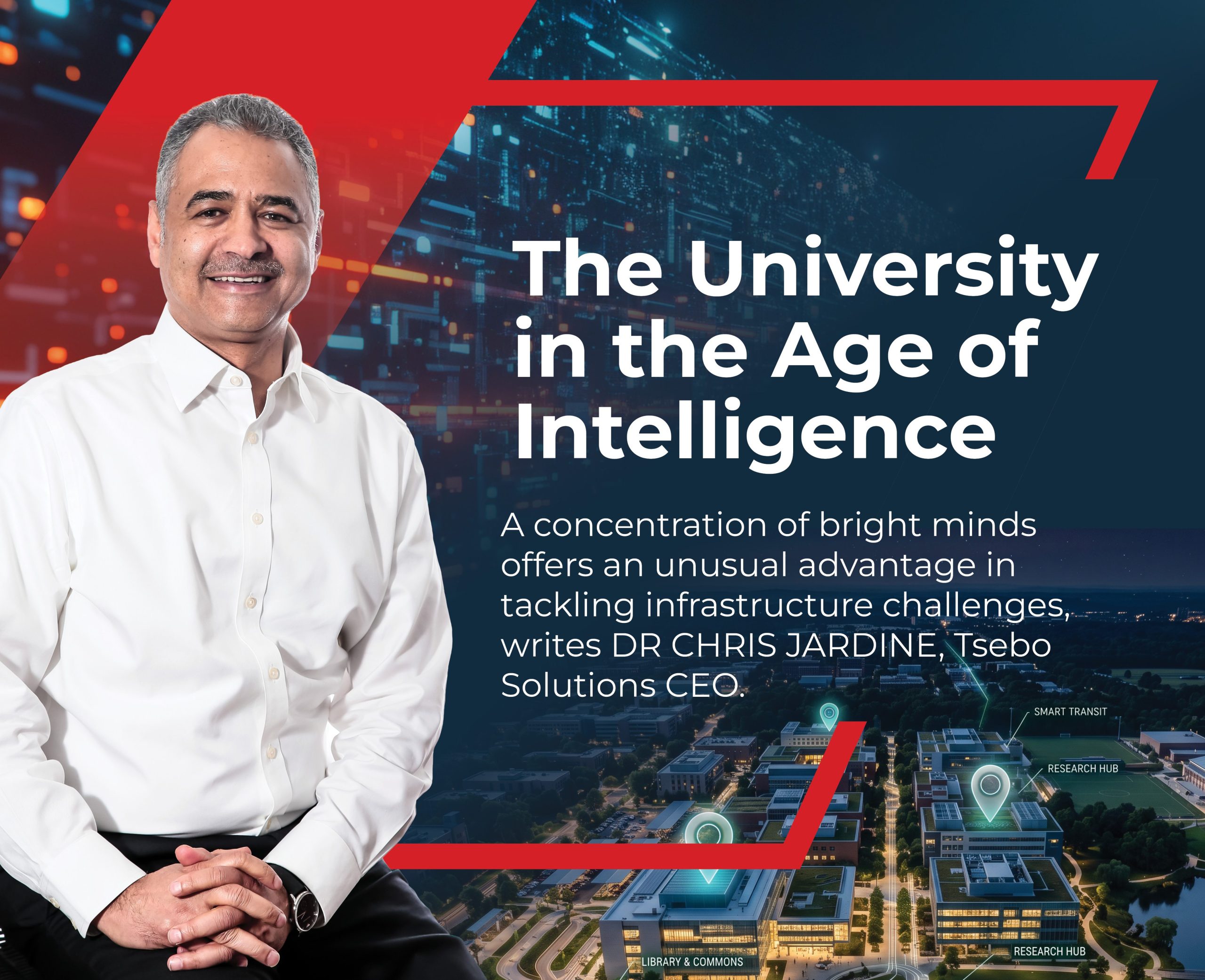
A concentration of bright minds offers an unusual advantage in transforming universities in a rapidly changing world, writes DR CHRIS JARDINE, Tsebo Solutions CEO.
Intelligence is becoming scalable in ways that would have sounded like science fiction a few years ago. And now, presentations and consultant-grade business plans take hours rather than days, avalanches of data are analysed in minutes, and more routine work is automated every day. For universities, the opportunity lies in how they integrate practical, scalable AI into everything they do.
The changing nature of academic research provides a window into the possibilities, with AI increasingly becoming part of the research process. AI is helping researchers navigate vast amounts of research literature, find connections and explore new pathways faster than small teams could manage unaided. The objective is to reduce the grunt work around discovery, giving researchers more time to question findings, exercise judgement and develop original ideas.
The opportunity extends much further, though. Universities face a demanding set of expectations and difficult trade-offs. They are under pressure to extend access, improve teaching and research, provide better student support and keep costs under control. Traditionally, doing more has required more people, more infrastructure and more money.
AI should alter that equation. Certain forms of expertise and support can now reach far more people without costs rising at the same rate. Making this work still requires investment in systems, data and people, but it gives universities the opportunity to achieve more with the resources already available.
Start with the student experience. Many university chatbots already do a good job of helping students find their way around, answering routine questions about applications, registration, deadlines, financial aid and who to contact. At Georgia State University, chatbot use has been extended into academic courses and more active student support, answering questions about course material and using reminders, encouragement and gentle nudges around assignments and other milestones to help improve outcomes. The university goes further still, using hundreds of different indicators and predictive analytics to identify students who may be at risk and trigger earlier intervention. An individual signal might mean little on its own, but together they can indicate when an adviser might need to check in. Students should obviously understand how their information is being handled, but used responsibly, this moves the university from simply helping students navigate the institution to recognising when someone may need support.
In teaching, AI tutors are beginning to make individual attention possible at a level few universities could otherwise afford. AI-enabled tutoring systems can increasingly create a learning experience that adapts to the individual student, presenting material in a style and at a pace suited to their progress. Sal Khan has described the ambition in compelling terms: the potential to give every student on earth a personal AI tutor and every teacher an AI teaching assistant. Universities do not have to build this capability from scratch. A growing body of research into adaptive AI tutoring and personalised learning, together with open-source platforms such as OATutor and freely available teaching resources, gives universities something to build on and contribute to. The bigger idea is individual attention at a level that conventional economics has never really allowed. This is a long way from the talking-head model of much online teaching, with support that can be interactive, personalised and responsive to the individual student. And because this support is digital, it extends the reach of quality, university-led teaching well beyond the physical campus.
Then there is the physical university itself. Imagine energy and water systems, buildings and other infrastructure increasingly equipped with sensors, with the resulting data brought together and monitored holistically rather than each system being viewed in isolation. This creates a much richer understanding of how the campus behaves. This could reveal where energy is being wasted, how space can be better utilised, where demand is changing and where equipment may require attention even before it breaks down. This shifts campus management from simply reacting to what has happened towards anticipating what is likely to happen, while reducing costs and the risk of disruption.
Universities have a distinctive advantage in tackling these challenges. They already bring together some of the brightest minds across multiple disciplines, with the expertise and problem-solving capability to address many of the challenges of the institution itself. The campus can become a place to experiment, solve problems, test ideas, learn and improve. Students and academics do not simply need to be users of the Intelligent University. They can help create it.
Part of getting there will undoubtedly involve connecting systems and things that today often sit apart. Universities generate enormous amounts of information across teaching, research, student services, finance, administration, facilities and the physical campus. Bringing more of that data and intelligence together creates a more complete view of the institution and how its different parts interact. It makes it easier to see patterns, trade-offs and opportunities across teaching, research, operations and the student experience.
That leads to a more ambitious possibility. Leadership could move from dashboards of past performance to an integrated decision-support environment that models what could happen next. What happens if enrolments grow in one faculty? How much additional capacity can the existing campus absorb? What does that mean for lecture space, residences, utilities, student support and cost? What happens if resources are shifted from one area to another? Instead of seeing the consequences of important decisions after the fact, increasingly sophisticated models create the possibility of exploring those consequences in advance.
The Intelligent University would take shape through those choices, with an integrated perspective on where to invest, what to connect, when to intervene and where human judgement matters most. Its success would be measured in broader access, better learning, higher graduation rates, stronger research and more effective use of resources.
After all, the purpose is not just to create more intelligence. It is to create more human potential.
Have a question or want to explore how Tsebo can support your business? Contact us today.